State Senator Vows to Tackle Foreclosure ‘Injustice’ After NY Focus-Gothamist Investigation

In response to reporting by New York Focus and Gothamist, State Senator Zellnor Myrie has introduced a bill to standardize debt calculations.
Chris Bragg and David Brand   ·   December 4, 2025
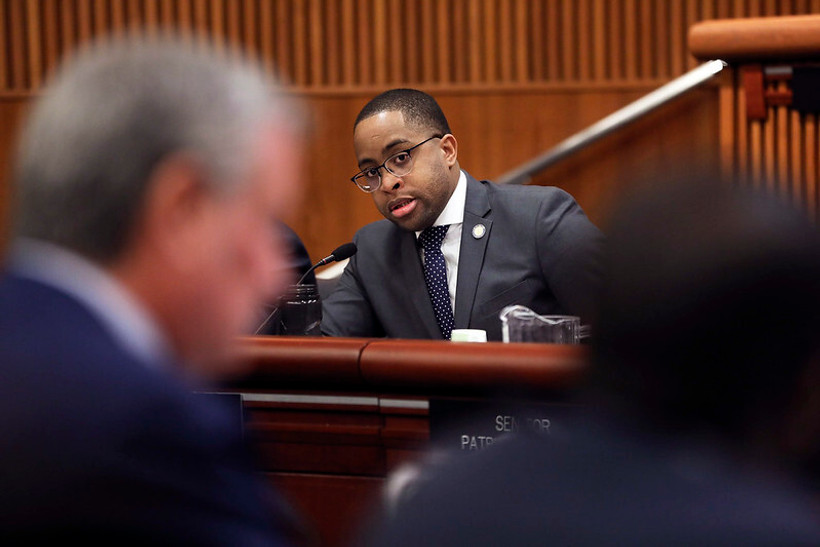
New York State Senator Zellnor Myrie has introduced a bill meant to prevent vulnerable homeowners who have fallen on hard times from “the double whammy of not just losing their home, but losing out on compounded interest that appears to be in contravention to what our current law states.” | NY Senate Photo

Sign up for Staying Focused, our newsletter keeping readers up to speed on New York politics.

New York State Senator Zellnor Myrie has introduced new legislation to impose consistent standards on foreclosure auction sales following a New York Focus and Gothamist investigation into widespread irregularities that can cost former homeowners thousands of dollars while boosting lenders’ profits.

The investigation, which was based on interviews and an independent review of thousands of state court records, found some lenders, their attorneys and court-appointed referees routinely used a disputed calculation method to increase debts owed by former homeowners following foreclosure sales. The method, which charges interest on top of interest, contradicts state court system guidance. Former homeowners allege in federal lawsuits that the practice also violates a state law prohibiting compound interest on residential loans and has gone unchecked by judges, referees and state court officials.

“At minimum, we need uniformity and transparency in this foreclosure auction process,” said Myrie, a Democrat representing parts of Central Brooklyn.

Myrie’s bill would require referees — attorneys tasked with overseeing the foreclosure sale process — to detail interest calculations in a single, uniform document used in every courthouse across the state. Currently, lenders’ law firms often use their own templates and referees sign off on their calculations without making changes.

Myrie said he also wants to explicitly bar lenders from charging compound interest during the period between when a proposed judgment amount was tallied and a judge approved it – a process that can take years. Such a statute would reduce debt owed by former homeowners and potentially allow them to secure more money after a sale.

He said his bill is meant to prevent vulnerable homeowners who have fallen on hard times from “the double whammy of not just losing their home, but losing out on compounded interest that appears to be in contravention to what our current law states.”

The legislation, Myrie said, is meant to correct “an injustice in the system” revealed by Gothamist and New York Focus’ investigation.

A spokesperson for the state’s Office of Court Administration, which manages court processes across New York, did not respond to a request for comment. 

The agency has allowed two methods of interest calculation to persist simultaneously, our analysis showed.

How much a foreclosed homeowner ends up receiving or owing following a foreclosure sale usually depends on which method their lender’s attorney happens to use.

Some law firms representing lenders use a mortgage’s “unpaid principal balance” to calculate interest, the same method prescribed by a sample template for referees currently issued by the Office of Court Administration. 

Others tally interest off a higher “judgment amount,” instead of a mortgage’s unpaid balance. Lenders, mortgage servicers and law firms named in the federal lawsuits have argued that their method is legal and a matter of “judicial discretion.”

While Myrie’s legislation would standardize the process going forward, it would not address the irregularities in thousands of past New York foreclosure cases.

Myrie said he has not discussed the legislation with court officials. 

“Attorneys should be sanctioned, because then everyone would do it correctly and no one would mess around.”

—Attorney Mark Anderson

The review by Gothamist and New York Focus found 14 law firms that used the disputed calculation method that increases homeowner debts about 95% of the time. Those firms handled at least 7,400 foreclosure cases that ended in an auction since 2013. In some cases, the difference in the two calculation methods exceeded $80,000.

Queens-based attorney Mark Anderson is representing former homeowners in the proposed class-action lawsuits attempting to stop the compound interest calculations and compensate them for their alleged losses.

Anderson said Myrie’s legislation was “a good first step” to codifying practices but that the bill needed plain language prohibiting compound interest before a judge’s ruling in order to align with existing state law.

He said state lawmakers should impose a single standardized form for every referee to use, and then require judges to approve the final sale report before the lender receives any proceeds.

He also said lenders’ attorneys or referees who tried to circumvent the rules should be punished.

“Attorneys should be sanctioned, because then everyone would do it correctly and no one would mess around,” he said.

At New York Focus, our central mission is to help readers better understand how New York really works. If you think this article succeeded, please consider supporting our mission and making more stories like this one possible.

New York is an incongruous state. We’re home to fabulous wealth — if the state were a country, it would have the tenth largest economy in the world — but also the highest rate of wealth inequality. We’re among the most diverse – but also the most segregated. We passed the nation’s most ambitious climate law — but haven’t been meeting its deadlines and continue to subsidize industries hastening the climate crisis.

As New York’s only statewide nonprofit news publication, our journalism exists to help you make sense of these contradictions. Our work scrutinizes how power works in the state, unpacks who’s really calling the shots, and reveals how obscure decisions shape ordinary New Yorkers’ lives.

In the last two decades, the number of local news outlets in New York has been nearly slashed in half, allowing elected officials and powerful individuals to increasingly operate in the dark — with the average New Yorker none the wiser.

We’re on a mission to change that. Our work has already shown what can happen when those with power know that someone is watching, with stories that have prompted policy changes and spurred legislation. We have ambitious plans for the rest of the year and beyond, including tackling new beats and more hard-hitting stories — but we need your help to make them a reality.

If you’re able, please consider supporting our journalism with a one-time gift or a monthly gift. We can't do this work without you.

Thank you,

Akash Mehta
Editor-in-Chief
A photo of Akash Mehta.
A photo of Chris Bragg.
Chris Bragg is the Albany bureau chief at New York Focus. He has done investigative reporting on New York government and politics since 2009, most recently at The Buffalo News and Albany Times Union.
David is a reporter covering housing for Gothamist and WNYC. Got a tip? Email dbrand@​nypublicradio.​org or Signal 9083103960.
Also filed in New York State

State leaders are expected to pass a bill that avoids resolving how much Resorts World New York City needs to pay.

New York state has pumped millions of taxpayer dollars into an online portal that vowed to make life easier for Rochester’s neediest, but critics say it’s fallen short.

Resorts World is floating legislation to avert more than $500 million in payments to the horseracing industry.

Also filed in Housing

Some of the city’s new aid will be canceled out by pension boosts.

A law designed to protect the environment will be partially rolled back to pave the way for much-needed homes.

After a New York Focus investigation, a Bronx charity distributed nearly $400,000 to survivors of a deadly 2022 fire.